

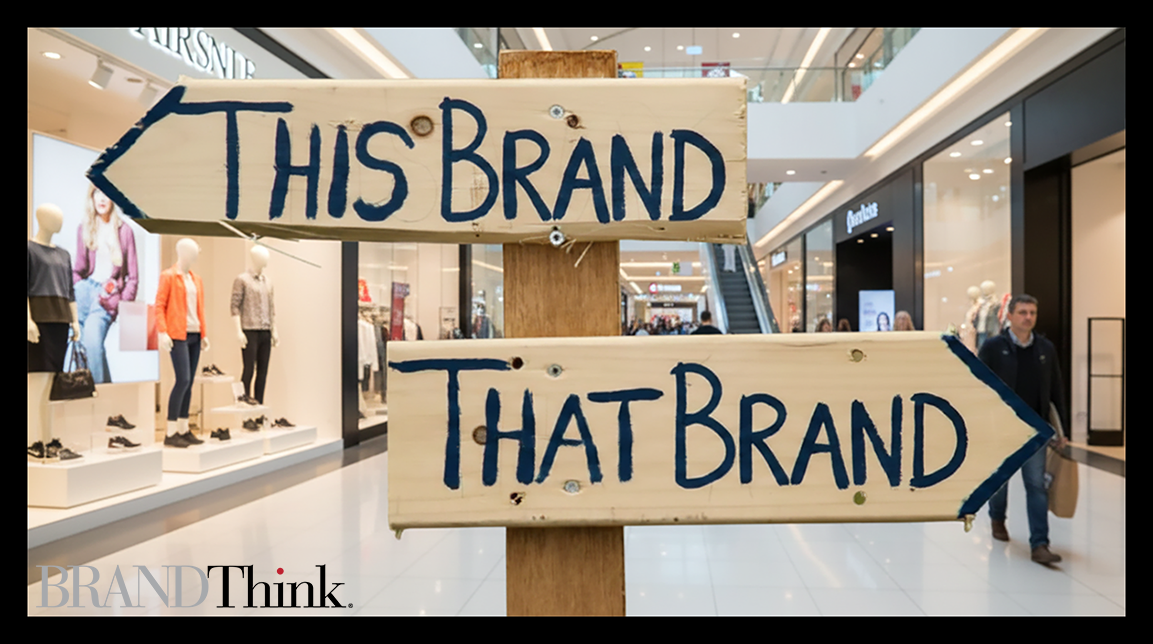
Leaders who believe in branding need to get this right: customers, investors, and even boards do not make rational decisions.
Consumers rely on instinct, familiarity, confidence, and emotions, then rationally justify and support those decisions with logic. This is not a failure of intelligence. It is how the human brain is wired. Understanding these human versus AI cognitive capabilities is crucial for brand strategists. This is why brand equity consistently outperforms product superiority, feature innovation, and rational persuasion when it comes to revenue durability and valuation. Brands work because they align with human nature.
If brand were simply a marketing tactic, it would not show up so reliably in valuation premiums, pricing power, and long-term growth. Yet it does.
Brand equity is not built solely through clever messaging, great design, or compelling customer experiences. Sure, these are important downstream tactics, but to truly own space in the hearts and minds of your prospects, you must understand how people think, decide, trust, remember, and attach meaning. Brand preference and loyalty are shaped by how you deploy tactics and by the accumulated value of correctly applied behavioral science over time.
To better understand this, we’re going to talk about Daniel Kahneman, winner of the Nobel Prize in economics, and one of the most important thinkers of his generation in human decision-making. While this is all about brands, Daniel did not study brands. He never built a brand. But he did study people and human nature. His work explains why some companies command price premiums, loyalty, forgiveness, and valuation multiples that far exceed their tangible assets, while others compete endlessly on features, price, and efficiency, always chasing the big dogs.
If you want to understand why brand intangibles drive enterprise value, revenue durability, and larger multiples, you have to start with human nature, not marketing theory.
How We Make Decisions
Kahneman’s arguments are deceptively simple and critical to understanding brand development. Human beings do not make decisions rationally and then act emotionally. They decide emotionally and then justify rationally.
In his book, “Thinking, Fast and Slow” (Farrar, Straus and Giroux, 2011), Kahneman explains that the brain operates using two systems:
- System 1 is fast, emotional, intuitive, and effortless. It runs on instinct. It is emotional.
- System 2 is slow, deliberate, and analytical. It runs on data. It is rational.
Many assume business decisions are logical and calculated, like System 2. In fact, they are System 1 decisions that only engage System 2 justification after the fact. People feel first.
This matters because brands live almost entirely in System 1. (Keep in mind the “know, like, and trust” thing that is so important to building brand equity.)
People do not experience brands (or make many purchase decisions) analytically. They experience them emotionally, instinctively. The feelings of trust, confidence, familiarity, or skepticism come before logic shows up. By the time the analytical part of System 2 enters the picture, the decision has often already been made.
From a leadership standpoint, this reframes brand entirely. Brand strategy is leveraging and aligning persuasion with how the human brain works. Understanding why leaders must commit to building brand becomes essential when you recognize that brand strategy isn’t just marketing—it’s behavioral psychology applied to business.
The Fluency Effect
Let’s remember what makes us human. We are emotional. We make emotional decisions. One of Kahneman’s most consequential findings that impact branding is that the brain confuses familiarity with truth. This is the rationale behind the frequency-over-time brand approach for building brand awareness. It is why alignment and consistency are so critical to building equity. Building a brand and realizing the financial returns that come with it is an ongoing, 24/7/365, always-on proposition.
It goes like this:
Repeated exposure creates cognitive fluency.
Cognitive fluency creates comfort.
Comfort is interpreted as safety.
Safety is interpreted as credibility. Comfort, safety, and credibility are the foundation for trust.
The brain doesn’t ask, “Is this true?” It asks, “Does this feel familiar and easy to process?” Familiarity removes doubt.

This phenomenon is repeatedly demonstrated in behavioral psychology and is the primary reason for single-mindedness in brand positioning. This principle of single-minded brand positioning is fundamental to building lasting brand equity. Statements that are repeated are more likely to be believed, even when they are false. Messages that are easier to process are rated as more truthful than complex ones. Say it enough times, and it becomes the truth. Source: Reber, Schwarz, Winkielman. “Processing Fluency and Aesthetic Pleasure.” Psychological Science, 2004.
This is branding from a behavioral science perspective. Consistency is a trust accelerator. Brands that change their language, positioning, or identity often devolve. They dilute existing equity, lower trust, and reset beliefs. The longer you remain consistent across all customer touchpoints and engagement, the more brand capital you build. Familiarity compounds. Trust builds. Revenue invariably follows. Implementing a comprehensive brand alignment strategy ensures these psychological principles are applied systematically across all organizational touchpoints. Real-world examples demonstrate brand equity’s measurable business impact when these psychological principles are applied consistently. Companies with this kind of brand equity often outperform technically superior competitors. Not because their products are better, but because consumers have already perceived and accepted them as safe, known, and true. This is where familiarity reinforces perception, and perceptions become reality.
This kind of brand capital is the foundation of trust, which becomes preference, and preference becomes lifetime value.
And lifetime value is everything.
The Halo Effect
Consider this in terms of the power and importance of brand image. Kahneman discusses the halo effect, a cognitive bias in which one positive attribute leads people to assume other positive attributes without evidence. If something looks premium, people assume it performs better.
If something sounds confident, people assume it is competent.
If something feels established, people assume it is successful.
If it looks and feels like quality, people will assume it is quality.
Interestingly, perceived competence sometimes precedes actual competence in the market. This is why first-to-market category leaders lock in an advantage that late entrants struggle to overcome, even when the late entrants are objectively better. A rare exception to this is Apple, which revolutionized the mouse, the digital music player, the cell phone, and tablets. Not the first, but clearly the best.
It is also why weak, poorly positioned brands struggle to gain adoption and grow, even when business fundamentals are sound. Brand confidence is not arrogance. It is a cognitive shortcut the brain uses to reduce risk and uncertainty. Smart brand strategists understand the importance of leveraging this psychology. This is precisely why building high-value brands requires a systematic approach that harnesses these psychological principles, which is where a comprehensive brand strength evaluation becomes invaluable for measuring and optimizing these psychological advantages, leveraging the same brand assessment frameworks that prove invaluable when evaluating brand equity in acquisition scenarios.
Prospect Theory And Loss Aversion
Prospect Theory, developed by Kahneman and cognitive psychologist Amos Tversky, holds that people don’t evaluate choices objectively. They react to gains or losses, feeling losses far more intensely than equivalent gains. In brand strategy, this translates into a powerful truth: audiences don’t choose brands based on absolute value but on how a brand might shift their perceived risk, reduce potential loss, and present outcomes in emotionally reassuring ways. A strong brand promises benefits and minimizes psychological loss, whether that’s fear of making a bad choice, missing out, or wasting money.
Losing one hundred dollars hurts more than gaining one hundred dollars feels good. In brand behavior, this means people are more motivated to avoid loss than to pursue upside. Once someone trusts a brand, leaving it feels risky. Switching feels like a potential mistake. Staying feels safe.
This is why trusted brands more easily earn forgiveness. Remember Tylenol? The psychological cost of leaving a brand feels more threatening than the dissatisfaction of staying. This is not loyalty in the emotional sense. It is risk management in the consumer’s mind.
Understand all this, and it becomes easier to connect the dots. Strong brand equity reduces revenue volatility and improves cash flow durability. Strong brands lower perceived downside risk, which directly impacts valuation multiples.
The Endowment Effect
Another important bias is the endowment effect. Here, people value something more simply because they own it, demanding far more to give it up than they’d be willing to pay to acquire it. This pattern is closely linked to the loss aversion we discussed above. Giving something up feels like a loss, and losses are psychologically heavier than gains. The endowment effect shows that people assign a higher value to things they already possess simply because they possess them. Once a customer feels a sense of ownership over a brand relationship, walking away feels like a loss.
The endowment effect plays big in brand strategy because once a consumer adopts a brand, they value it disproportionately and become resistant to switching. Strong brands intentionally cultivate this sense of psychological ownership, turning preference into stickiness and making switching to a competitor feel like a loss rather than a gain. The endowment effect drives retention.
This shows up in marketing strategy. Apple does not just sell devices. It creates psychological ownership and, thereby, a brand commitment. Costco does not just sell value. It creates membership identity. Switching becomes psychologically difficult.
Ownership changes the valuation equation in the customer’s head.
The Peak-End Rule
We live in a world of brand experiences, and this rule also plays big. The peak–end rule matters because people judge a brand experience almost entirely by its most emotionally intense moment and its ending, not by the overall experience. It is how we remember experiences in general. This means brands win when they deliberately engineer a standout peak moment and a strong finish. The peak-end rule shows that people judge an experience by its emotional peak and ending. These two moments disproportionately shape memory, loyalty, and word‑of‑mouth. Brand equity is built at emotional inflection points.
This is why onboarding matters more than feature depth. Why service recovery matters more than service speed. It’s why how a brand relationship ends shapes how it is remembered. The peak-end rule should help leadership reframe customer experience as a brand equity investment. Experiences are engineered memories.
The Availability Heuristic
Behavioral psychology shows that people judge importance based on what comes to mind easily. Related to the Fluency Effect, this is called the availability heuristic. High brand awareness, or brands that are mentally available, are perceived as leaders. Visibility creates assumed scale, credibility, and trust. Presence creates perceived dominance. It’s why brands like to buy Super Bowl ads. For these very reasons, share of voice often precedes share of market. It also explains why being known beats being differentiated. (Not at all discounting differentiation here.)
From an enterprise value standpoint, mental availability, or awareness, is not a marketing metric. It is a risk perception metric. Investors, partners, and acquirers are subject to the same cognitive biases as customers. Founders take note.
The Affect Heuristic
The affect heuristic posits that people rely on emotional impressions to make complex judgments quickly. This bias shapes brand strategy because people judge a brand’s risk, trustworthiness, and value based on how it makes them feel rather than on its factual attributes. When a brand consistently evokes positive emotion, customers automatically perceive it as safer, easier, and more rewarding, giving it a significant advantage in crowded or parity categories.
If they feel good about something, they assume it has positive attributes. If they feel uneasy, they assume risk. For many brands, this explains why emotional resonance can often outperform rational proof. It also explains why price premiums are sustained by feelings, not by feature comparisons.
Why All This Matters
Intangible brand equity is often dismissed as a credible asset because it can’t be captured on balance sheets. Thinking this way is a mistake. Just because it’s hard to measure, does not mean it is not there. Strong brands reduce customer acquisition costs, stabilize demand, increase pricing power, improve retention, and lower perceived risk. Those are not marketing outcomes. They are financial outcomes.
Multiple valuation studies, including peer‑reviewed research from Interbrand, Brand Finance, and Kantar BrandZ, all show a significant correlation between brand equity and enterprise value, with brand representing a significant share of total enterprise value. While the numbers cannot be verified, many estimate that 30-50% of enterprise value is attributable to brand.
Businesses with durable brand equity trade at higher multiples because their future cash flows are perceived as more reliable. They have a lower risk profile and a higher likelihood of future success. For founders, a strong brand reduces the cost of capital for all the reasons we’ve discussed.
Brand is not an arbitrary thing. It is a risk-reduction system built on human psychology.
Instead of asking, “How do we communicate our value better?” ask, “How are we aligning with human nature and how people actually think?”
Building brand equity requires respecting the cognitive realities of being human. This systematic approach to building lasting brand equity transforms psychological insights into actionable strategies.
- Consistency creates belief.
- Confidence creates trust.
- Familiarity creates safety.
- Emotion creates meaning.
These are not creative variables; they are documented features of human cognition. Brand intangibles are not abstract. They are accumulated psychological advantages.
Companies that understand this stop treating brand as a function or a line item and start treating it as a strategic construct. They understand that brand strategy is less about marketing and more about value creation and connecting emotionally. And they integrate this thinking into their operating philosophy.
This is when brand starts delivering like the asset it is.
***
Rant, pontificate, agree or disagree, but please do opine. We’d love to hear your thoughts. If you found the article read-worthy, we’d be grateful for a like and a share with your community.
About the Author: Lysle C. Wickersham leverages his background in both advertising/branding and investment banking as co-founder of BRANDThink, LLC, a strategic brand positioning and management consulting firm supporting startups and early-stage businesses, SMEs, and PE/VC’s in amplifying value creation, providing brand diligence, and brand strategies to build high-performing and high-value brands. Lysle on LinkedIn. BRANDThink on LinkedIn.